
Interview Series: JEANNINE BUTLER Founder of Durham Shoestring Performers

2026-07-15
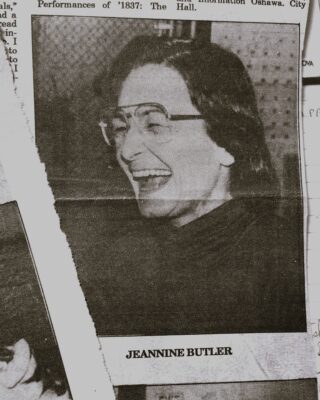
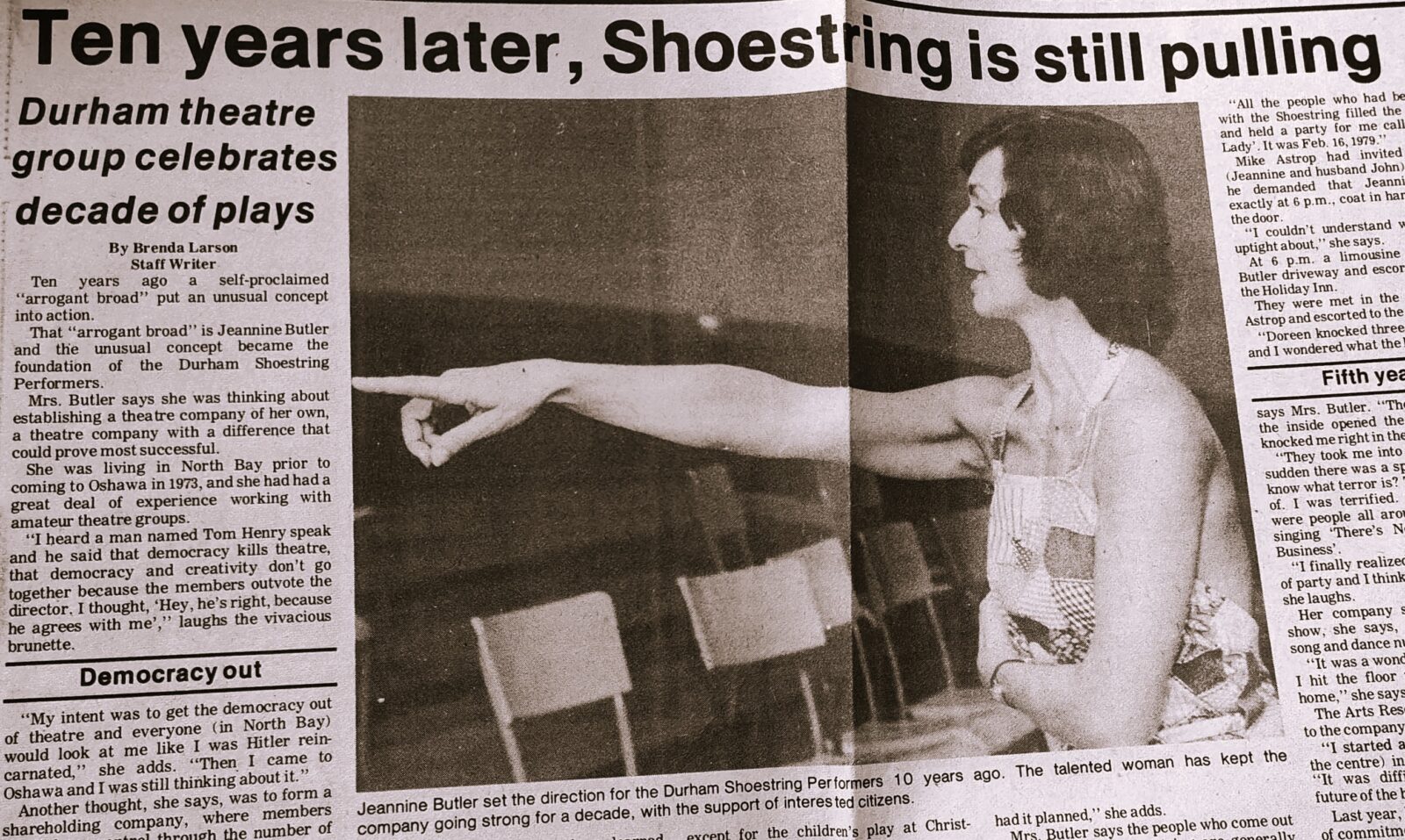
Jeannine Butler founded Durham Shoestring Performers over fifty years ago; DSP had staged its first production in the fall of 1974 under her Artistic Direction. This company began as an indefinite experiment to test her alternate vision of what a community theatre could be; Butler set out without a sense of what would become of this project beyond the initial hypothesis she pursued for her own satisfaction.
Butler retired from her post in 1990— a staggering 16 years after the founding of this unexpectedly successful experiment— placing it, and her trust, into the hands of Carolyn Wilson, who has been with the company since its founding year; now accompanied by the Board of Directors established in 2022. It speaks only well of Butler and her leadership to have instilled many of her companions with such a devotion as to carry her work onwards, even onwards from today.
I became interested in the story of this unique artistic community, and it was through Wilson I first learned a great deal about DSP’s history and founding director, to whom she accredits everything. I soon had the pleasure of meeting Butler for myself, when she visited a rehearsal for The Moors, which Wilson directed in the ‘24-‘25 season.
Over the year to follow I enjoyed small occasional interactions with Butler, and after transcribing 16 years of documented history about her leadership I arranged to meet with the woman, hoping to chat more personably now that I knew so much about her by way of editorials.
The interview transcripts I have provided below account for hardly a third of our conversation— as it was a conversation more than it was an interview— but you will find here glimpses of her character and convictions across these fairly informal questions. I regret how little the written word can communicate the warmth and affection she imparted that afternoon; neither can words communicate the animation of such a vibrant woman, her electric and elastic expressions, her cheeky and conspiring tones and wit, and, above all, the nearness that became of us two strangers in our chairs.
Oetta Ryan Geraghty
Geraghty: [How did you and your band of Shoestringers make out in those early years?]
Jeannine Butler: I wish I could give you a [clear] answer to that, but I really don’t remember how we worked it out. We just kinda did— we didn’t even have a theatre, you know? […] Everybody kind of did everything. We got paint from one of the companies and whoever was available came and painted the wall.
I can’t remember the specifics of things, I just remember the espirit of the whole thing, how everyone was just… keen on doing something. I’m not sure if I thought much further than one year, I just wanted to get something going.
Geraghty: You thought, “Maybe two years, maximum.”
Butler: Yes. I did remember saying to John [Butler]* once, “If I can keep it together five years, I will say that’s an accomplishment.”
Geraghty: And that was your biggest celebration, it seems like; with your one hundred people after just five years, to show up to celebrate you.
Butler: That was magnificent.
*Jeannine’s late husband: John Butler was a Lighting Technician, and an instrumental member of DSP from the beginning
Geraghty: I think it’s funny, on the topic of the building. I read, in ‘85-‘86, when the [City of Oshawa renovated the Arts Resource Centre, the auditorium was outfitted with new] chairs— instead of the plastic ones— and you marveling how comfortable they were, how wonderful it was.
Butler: We came up with the cushions— after a couple of years we said, “No, those chairs really aren’t comfortable.” We came up with the cushions! And she— I was so surprised when I came back and [Carolyn]’s still using the cushions. I thought, “Oh my God, I thought they would have fallen apart by now.” They lasted better than I did!
Readers might like to know: While the concept of their handmade cushions has remained, they are not literally the same cushions all these years later– but, in fact, have been remade!
Geraghty: [Dozens, even hundreds, of people are recorded as being involved in DSP across the first decade or so, and only very few of those names are recognizable to members today besides Carolyn Wilson, and Jeff Kellar, who joined in its fourth season]. Did you get an immediate impression that Carolyn was going to be somebody as devoted [as she was]?
Butler: She was just kinda always there, you know? It just seemed we didn’t finish one thing that we were planning the next. Nobody ever said, “Are you with me? Are you going to stay and do this?” We just kinda drifted.
I don’t know if she’d have the same response as I would. But, to me, I just don’t remember saying, “Are you okay with this?” or, “Do you want to do this?”
We’re just moving along. We finish one and we start on the next one. [It never crossed my mind]— until five years; when we finished five years it suddenly sunk in that maybe this company was going to last.
But, it just seemed… ah, I keep having this image of a flowing river; you just don’t decide whether you’re going to go or not, you just go. It sounds, maybe, not too bright. You should make some plans in your life!
Geraghty: I think that’s what moves me so much looking at those pages of names [of volunteers], and wondering how many of those people expected [DSP] to be some great big thing, or how many of those people expected to stick around for years, continuing to do it.
Butler: I would like to pick Jeff’s brain, and see if he has any concept of what he thought at the time he came in. [DSP] just grew and grew.
Geraghty: Yet nobody’s heard of it! I saw DSP described as “Oshawa’s Best Kept Secret” [in The Oshawa Times, January, 1990].
Butler: Ah!
Geraghty: And, “best”, I think, in the sense that it is a very well-kept secret, but it’s also an amazing secret.
Butler: Yes, best kept secret it is.
Geraghty: Have you ever been surprised by DSP?
Butler: Constantly. Constantly. Everything surprised me about everything I did. Everything that happened on stage was always a surprise. Do you know what I mean?
Geraghty: I think so.
Butler: Every night that there was a show on and I sat in the audience and thought, “Isn’t this wonderful.”
Geraghty: I’ve heard the phrase, “You want every show to give the illusion of the first time.”
Butler: Well, it is! It is!
Geraghty: Every night is a little bit different.
Butler: Always.
Geraghty: I think that’s what amazes me about theatre, about […] anybody who works a life in the theatre. It happens, and then it’s gone.
Butler: It’s gone.
Geraghty: You might have photos, but it’s not the same, and it’s over.
Butler: It’s gone.
Geraghty: Hundreds of hours from so many people for so long, and unthinkable amounts of labour, and it’s gone.
Butler: Think of the sand sculptors; those sculptors who work with sand, working to beat the [tide], and they know— they know they’re building something that’s waiting to be destroyed.
Geraghty: It’s marvelous and terrifying; I want to be able to point to something and say, “Look what I’ve done.” And theatre, purely— there’s nothing more present than: You go.
Butler: There’s something about live that’s just live. You can put a camera on it, but it’s no longer live. You sit [at the cinema] and watch a perfectly wonderful film. But you’re not wondering if anything’s going to go wrong, because you know it’s not, because it’s a movie, it’s going to be perfect, it’s going to end up right. In theatre you never know. The next minute, the guy in the wheelchair is going to take off!
Geraghty: And you never know if you and your friend sitting beside you are going to burst out sobbing out of completely nowhere!
Butler: Exactly. Nice to have that kind of experience though!
Geraghty: Yeah!
Butler: I always aim to go opening night, I really want to see opening night. This is my personal [preference]: On opening night, I will see what the director was going for, what the director wanted. By the second night every actor has heard from somebody how they should play it, and without even meaning to, those little changes sneak in. I want to see what a director really meant to do. I may not, because she might never have gotten what she wanted, but I’m going to see what she ended up with anyway. […] Everybody else is influencing you!
If you come off stage and your mother says, “Why in the world did you do such-and-such a thing?” You start saying, “Well, why did I do that? Is there another way of doing it? Well, maybe I should have—?” Oh, you’ve lost what I gave you.
So, my aim is always to go opening night. And I know that, very often, the show’s the best on closing night.
Geraghty: Yeah— I feel a lot of people say they like to go closing nights.
Butler: Oh absolutely. Or at least wait for the second week! No, [not me].
Geraghty: I know some people who like to see opening night and then going to see closing, a second time. [It’s exciting to see how a show evolves in its lifecycle.]
Butler: Oh, I can see that!
Geraghty: But that’s a little more expensive!
Butler: Not only that, but in my case, I would be highly critical, I mean I would just be comparing every single [thing]. I would spent the whole night going over and over what didn’t work, and what worked, and what didn’t work. Not my own play!
Geraghty: Do you still feel like DSP is producing brave and challenging plays?
Butler: Yes, absolutely. Absolutely. I am so proud of everything Carolyn’s done with it. […] She’s kept the spirit of it, and for that I’ll be forever grateful. She’s kept the community concept, it’s not just— you don’t come and play your part and go home. You become part of the community, you become another addition to the community.
Geraghty: I think she just has that effect— and I’m sure you had that effect on people, too.
Butler: Yes, but it was a lot easier for me, you know, it was a smaller— everything was smaller. We put up eight lights; there was a little board that had six switches on it. It’s a different world.
Geraghty: It’s surreal to have the experience of talking about somebody so much, for so long: Two falls ago I was going through all the DSP [digital] archives, and developing a fuller picture [of the company and its history], and in the spring I was reading the huge stack of plays [DSP has produced], and then getting to actually meet you, and to go and see a show with you and Jeff and Carolyn— and you’re there, but I’ve never, we’ve never spoken.
And there’s something kind of— because you’re almost like a mythological figure, in a way. You’re just, this—
Butler: Ninety-year-old lady!
Geraghty: No! It’s just this kind of looming presence—
Butler: No, I know.
Geraghty: —That you’re in every little crevice of DSP. But, realistically, you’re here. I’ve met you! But, we’ve never had a conversation.
Butler: But, I’m nobody!— Ah, speaking of that night we went to that play. And you and Carolyn had to talk about [something]. And all I wanted to do was talk about the play!
Butler: I like to, on certain occasions, if I’m really impressed with somebody’s performance, and I can, I stay after the play— I don’t like that mixing around— but when I need to, I’ll stay after the play and compliment somebody on a performance, for whatever reason, and I usually try to be very clear about [my compliment]. And most of the time these people don’t have any idea who I is [sic]; three quarters of the people who are in the company now, they don’t know who I am. And, so I just try [to stay undercover]— and if Jeff Kellar is in five meters of me, he will say to the actor, “You know who that is?” No, Jeff, I just wanted the compliment to be private!— And he knows it bugs me, he knows!
But once— just once— I said to an actor, and I don’t even remember the play, or who the actor was, I said, “That was an incredible performance. I’m Jeannine Butler, I started this company.”
And I stood with myself [thinking], “What the hell are you doing?”— I just felt that [the compliment] would have more weight, if I expressed—!
Geraghty: Bring out the, “Do you know who I am?”
Butler: “Do you know who I am?” Yes! And I thought of Jeff as soon as it came out of my mouth, “Thank God Jeff isn’t here, I’d never hear the end of it!”
Geraghty: I remember the first time you came and visited [a rehearsal] for The Moors, because you couldn’t [make the showings]— you were going to Florida or something—
Butler: Yes, mhm!
Geraghty: And I saw you come in, and I overheard Carolyn say, “Oh, hi Jeannine,” and you went in to sit down— and because I had a lot of conversations with Carolyn, I knew the name ‘Jeannine’, so I thought “I have to go meet her!” And then I went and introduced myself. […]
And another day— basically any time you’ve come— so, I’ve— sorry: I’ve been Jeff. Any time you come in and I’m with friends I go, “That’s Jeannine!”
Butler: Oh! Ahaha!
Geraghty: Why do you think theatre is important?
Butler: Well, I can only speak on this level: It’s what I have always said about forming community. I think we all need— we as human beings, I mean— all need to be part of community. It doesn’t matter what the community is, whether it’s five neighbours in your neighbourhood, that’s a community, too.
Theatre allows you that privilege of forming a community at the same time as you being somebody else. You, yourself; you and me. You get on stage and I play the director, and we’re no longer You and Me, we’re now in a whole different world, we’re living in a different world. But we’re going to come back, together. Where do you get that, except theatre? It’s important. It’s important you can have that kind of community that you can count on and separate from, quickly and easily.
Geraghty: And it’s one where people have to rely on each other, and have to trust each other.
Butler: Trust.
Geraghty: You trust that your scene partner is going to know their lines, that your director is going to show up to every rehearsal.
Butler: And trust that he or she knows what they’re doing!
Geraghty: There’s not a lot of spaces where [community can be fostered]— especially nowadays, as everything has become alienated and isolated.
Butler: And so much depends on the dollar. Nobody’s getting paid here, you know— we’re all at the same level. I’ll give my time, you’re giving your time […] You’re giving it freely.
Geraghty: And it says something; the people who are willing to do that are the people who are going to care.
Butler: Yes, and it do the best they can, in whatever capacity.
Geraghty: What do you think it is about the medium of theatre that meant so much to you? You had a lot of experiences [in theatre] before DSP; that’s how you knew you wanted to make DSP, being sick of the way other theatre companies approached things.
Butler: Certainly that was one of the things— I was concerned about a Board, a whole Board deciding. And with most community theatres a Board decides what the schedule would be, who the next director will be, who will direct what play; that’s the norm. And the Board of Directors was always made up of directors, actors, people who want to perform— and I thought these were the wrong people to be making tough choices. Just find one person. One totally biased person!
But there was something wrong about— and I still agree with that— something wrong when you put creative people together to make decisions about something that is really a business thing, you know, too many other elements. If you can only see the play in terms of, “Oh, I always wanted to play Cassandra, we have to do— that’s the play we have to do this year!” This is not a good way to decide a schedule.
Geraghty: Especially when there’s conflicting opinions about that!
Butler: Yes! Because no director wants to do it— four directors you have for next year, they want to do anything but! So, this is not a good way to build a season. Not just a season— anything that ties… I don’t know.
On a personally selfish level, there’s a community of people there who give their heart, and that’s really important. You can learn more about yourself by trying to learn more about the people you work with. And that’s not just theatre, I know that happens in the art world, in all kinds of, in the writing world— but, for me, it was [theatre]— it works.
My personal theatre experience— early, early— was that sense of community, and the sense of learning from other people’s feelings. Feelings. Not what they do and say, but, what they show you about what they feel about things. That’s what’s important in a community. Is [theatre] the only way? No. But for me, it was the easiest way for me to move into [the world].
[John and I] happened to move into Oshawa. And I thought, “Maybe this is a good place for me to start A Something. And I mentioned it to somebody, Audrey McLean, [an artist who would become one of the founding members of DSP], I kept saying to Audrey, “Some day I’m going to do this.”
And I did it.